The Top Pharmacy Schools in Ethiopia
Ethiopia's pharmacy schools moved from a product-focused degree to a five-year clinical one in 2008, and the number of pharmacists per person has risen more than twentyfold since. Here is how the schools compare on the rankings that cover pharmacy, what each one offers, and what to check before you enrol.
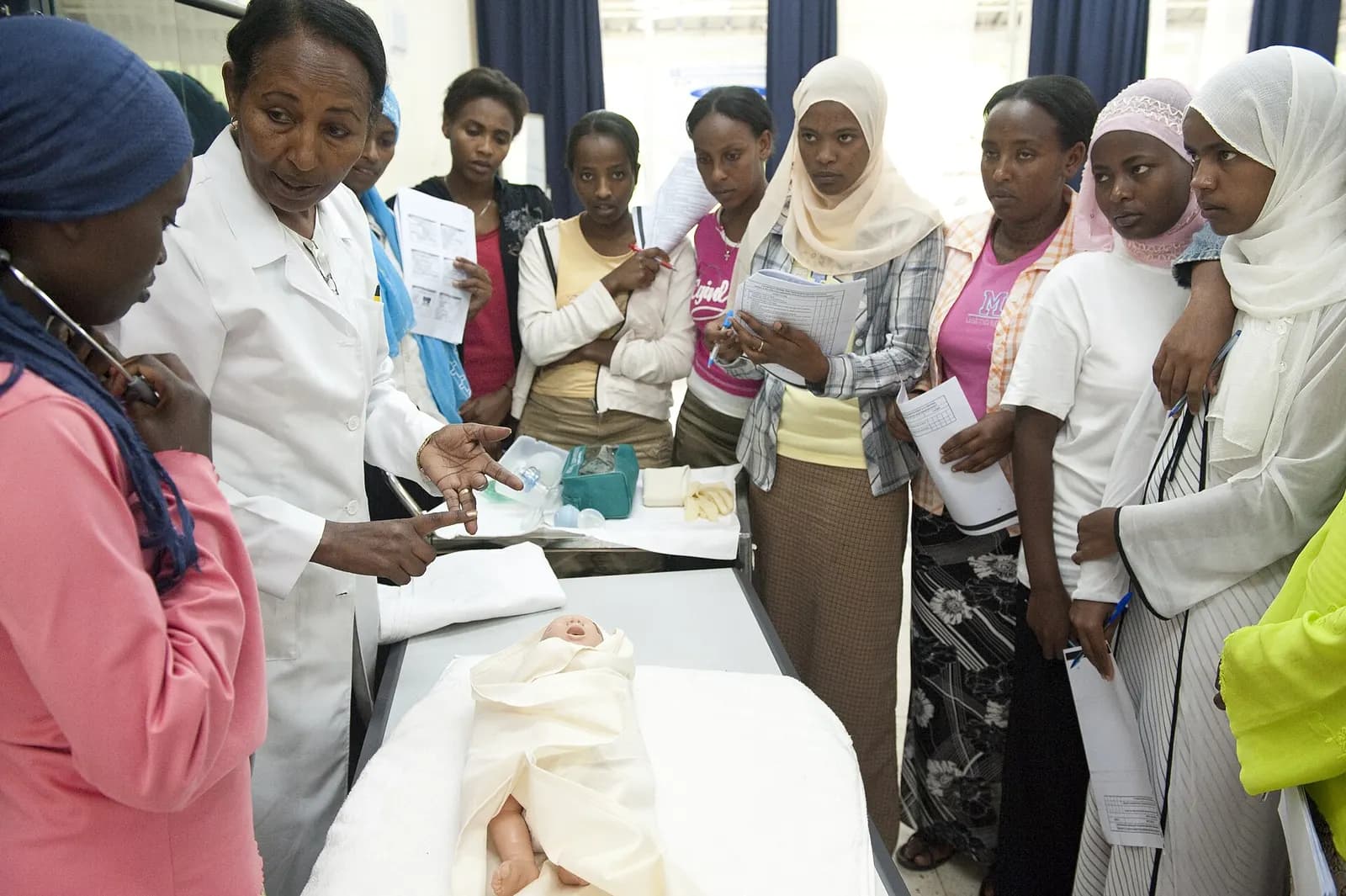
For most of its history, Ethiopia trained pharmacists to make, store and supply medicines. In 2008 the public universities rewrote the degree. The new five-year Bachelor of Pharmacy is built around patient care, and its final year is a clinical placement in hospitals and community pharmacies. The first 426 graduates of the new curriculum finished in July 2013 and were deployed to public hospitals across the country.
The workforce has grown quickly since then. WHO data put Ethiopia at 0.07 pharmacists per 10,000 people in 2009 and 1.62 per 10,000 in 2024. That is now almost twice the sub-Saharan African figure (0.85 in 2023), but still far below the world figure (5.78). (WHO's early figures and the 2010 national census, quoted below, count differently, so they don't match exactly.)
So which schools are the strongest? Fewer ranking lists cover pharmacy than medicine, and those that do measure research rather than teaching. We put them side by side and added what the schools and the research literature say about each one.
The short answer
The University of Gondar, Addis Ababa University and Jimma University are the leading three. Gondar is first on EduRank's pharmacy list and Addis Ababa is first on its pharmacology list. Jimma is third on both. Bahir Dar is the only other school on the pharmacy list. Mekelle, Haramaya, Hawassa and Debre Markos follow on pharmacology.
Ethiopia has more than a dozen public pharmacy schools, plus private colleges. The schools not listed here are not necessarily weak. Ranking sites only list universities that publish enough research to register.
How the schools compare across ranking sites
| School | EduRank Pharmacy 2026 (Ethiopia / world) | EduRank Pharmacology 2026 (Ethiopia / world) | uniRank 2026 (Ethiopia, whole university) | Research university (2020) |
|---|---|---|---|---|
| University of Gondar | 1 / 1,272 | 2 / 1,158 | 2 | Yes |
| Addis Ababa University | 2 / 1,464 | 1 / 1,004 | 1 | Yes |
| Jimma University | 3 / 1,965 | 3 / 1,568 | 3 | Yes |
| Bahir Dar University | 4 / 2,346 | 6 / 2,323 | 4 | Yes |
| Mekelle University | — | 4 / 1,885 | 5 | Yes |
| Haramaya University | — | 5 / 2,248 | 7 | Yes |
| Hawassa University | — | 7 / 2,546 | 6 | Yes |
| Debre Markos University | — | 8 / 2,669 | 19 | No |
A dash means the school does not appear on that list. EduRank's pharmacy list has only four Ethiopian universities, and its pharmacology list has thirteen. Wollega, Mizan-Tepi, Debre Berhan, Adama Science and Technology and Arba Minch universities fill places 9 to 13 on the pharmacology list. "Research university" is the Ministry of Science and Higher Education's 2020 classification.
How to read this
- EduRank is the only site with pharmacy-specific lists. It counts citations to research papers in the subject: about 11,000 citations to 734 papers for its pharmacy list. It does not separate undergraduate from graduate programmes, and it says nothing about teaching.
- uniRank ranks whole universities by web popularity. It is useful for seeing which universities are most visible online and tells you nothing about pharmacy.
- No list covers the private colleges that train pharmacists and pharmacy technicians. Check those yourself (see below).
The schools, one by one
 1. Addis Ababa University, School of Pharmacy
Profile, contacts and photos →
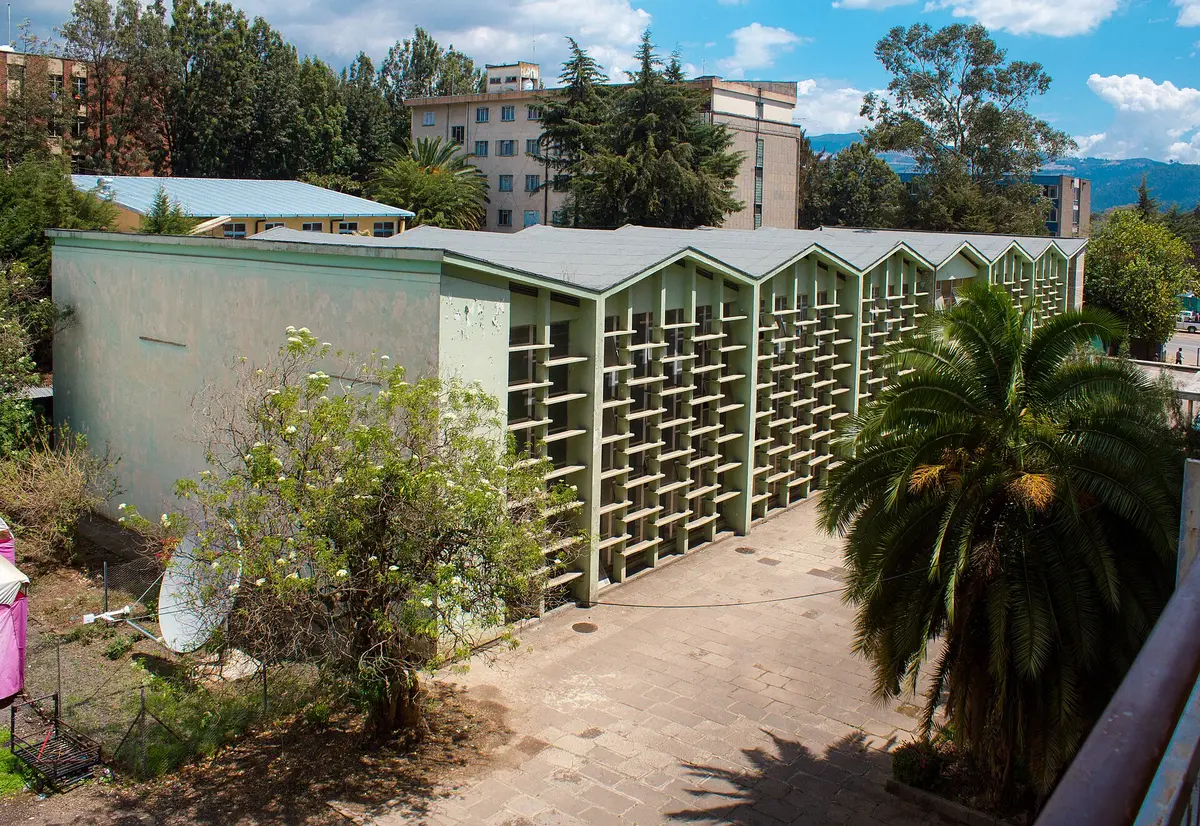 Photo: The Chroniclers, CC BY-SA 4.0, via Wikimedia Commons
Ethiopia's pharmacy education starts here: the bachelor's degree in pharmacy at Addis Ababa dates to 1961. The school's buildings were originally built for the German School in Addis Ababa between 1957 and 1961. Today it is one of four schools in the university's College of Health Sciences, which was formed in 2009/10.
Addis Ababa led the move to clinical pharmacy:
- The new degree: a 2007–2014 partnership with Howard University in the US helped develop the five-year, clinically oriented B.Pharm in 2008. It also trained 40 pharmacists and physicians as preceptors to supervise final-year clinical placements.
- Drug information: its teaching hospital, Tikur Anbessa (Black Lion), set up Ethiopia's first drug information centre in 2009.
- Graduate training: since 2008 a collaboration with the University of Toronto's pharmacy faculty has supported master's and PhD training in social pharmacy.
Course directories list two-year master's programmes in clinical pharmacy, pharmacology, social and administrative pharmacy, pharmaceutical analysis and quality assurance, pharmacognosy and medicine regulatory affairs. Confirm the current list with the university, as these directories are not official.
Addis Ababa is first on EduRank's pharmacology list and second on its pharmacy list.
 2. University of Gondar, School of Pharmacy
Profile, contacts and photos →
Gondar's School of Pharmacy was founded in 2000 and first trained pharmacy staff at diploma and bachelor's level. It has since become the country's most-cited pharmacy school.
- Clinical teaching: in 2012 Gondar recruited two clinical pharmacy graduates from Jimma and two Doctor of Pharmacy (Pharm.D) holders from India to set up a clinical pharmacy unit for final-year students.
- Postgraduate training: in 2015 it became the second Ethiopian university to offer a master's in clinical pharmacy. This two-year programme includes a 38-week internship across internal medicine, paediatrics, surgery, oncology, psychiatry and other wards.
- Research: a 2018 review by a Gondar faculty member counted 234 PubMed-listed clinical pharmacy papers from Ethiopia between 2012 and 2017, and attributed 101 of them to Gondar's clinical pharmacy staff.
That research output is why Gondar is first in Ethiopia and 42nd in Africa on EduRank's pharmacy list.
 3. Jimma University, School of Pharmacy
Profile, contacts and photos →
Jimma's school opened in September 1985 under the former Jimma Institute of Health Sciences. According to the university, it was the first in Ethiopia to offer a regular pharmacy diploma, and it started regular bachelor's classes in 2001.
Jimma has the widest range of graduate programmes here:
- MSc in Clinical Pharmacy (from 2009): Ethiopia's first postgraduate clinical pharmacy programme, set up with support from the University of Washington.
- MSc in Pharmaceutical Supply Chain Management (from 2013).
- MSc in Pharmaceutical Quality Assurance and Regulatory Affairs (from 2014).
- PhD in Pharmaceutical Sciences.
The school's first graduates of the patient-oriented bachelor's degree finished in 2013. Jimma is third on both EduRank lists.
 4. Bahir Dar University, Pharmacy
Profile, contacts and photos →
Bahir Dar is the youngest school on the pharmacy list. The university created its pharmacy department in 2017 and upgraded it to a Directorate of Pharmacy Education and Services in 2024. It is fourth on EduRank's pharmacy list, which counts the whole university's pharmacy papers, not only the department's. Its students train in a College of Medicine and Health Sciences that dates to 2007.
 5. Mekelle University, School of Pharmacy
Profile, contacts and photos →
Mekelle was one of the first schools to document the move to clinical pharmacy. A 2011 case study by its own staff described how its first B.Pharm class graduated after a four-year, product-focused course, and how it was preparing a patient-centred curriculum. It is fourth on EduRank's pharmacology list.
Like the rest of the university, the school was badly disrupted by the 2020–2022 war in Tigray. Our guide to Ethiopia's medical schools covers what happened to its teaching hospital.
 6. Haramaya University, School of Pharmacy
Profile, contacts and photos →
Haramaya's School of Pharmacy sits in its College of Health and Medical Sciences on the Harar campus. It includes a Department of Clinical Pharmacy, and Hiwot Fana Specialized University Hospital is on the same campus. Besides the regular degree, Haramaya offers a post-basic pharmacy programme, the usual route for diploma holders to upgrade to a degree. It is fifth on EduRank's pharmacology list.
 7. Hawassa University, Pharmacy
Profile, contacts and photos →
Pharmacy is one of the directorates of Hawassa's College of Medicine and Health Sciences. The college has 2,644 students across 41 programmes. Hawassa is seventh on EduRank's pharmacology list and sixth on uniRank.
 8. Debre Markos University, Department of Pharmacy
Profile, contacts and photos →
Debre Markos shows what most of Ethiopia's newer pharmacy schools look like. Its department opened in 2008 in the Ethiopian calendar (about 2015/16) and offers one regular undergraduate programme.
- Staff: 40 academic staff, 13 with master's degrees and 27 with bachelor's degrees. The department says 20 staff are on study leave.
- Plans: it is working towards its first master's programme, in pharmacology, and a post-basic pharmacy degree.
It is eighth on EduRank's pharmacology list.
Also worth knowing
- Ambo University launched its pharmacy department in 2010 using the national harmonised modular curriculum. A 2021 study counted 275 students in its regular and non-regular programmes.
- Wollega, Mizan-Tepi and Debre Berhan universities also appear on EduRank's pharmacology list.
Private colleges: check the accreditation first
Many private colleges offer pharmacy at degree or diploma level. Accreditation is set programme by programme, so a college can be licensed for one course and not another.
- 2019 audit: the regulator then known as HERQA audited 167 private institutions in and around Addis Ababa and found irregularities at 46.
- 2019 closure: later that year it closed Paradise Valley College's Adama campus for registering and teaching pharmacy students without accreditation. The college's dean disputed the allegation.
- 2026 revocations: the Education and Training Authority (ETA) revoked the licences of 52 private colleges for failing regulatory standards. The published reports do not say whether any of them taught pharmacy.
Before you pay a private college, ask for the ETA accreditation letter for that programme at that campus, and confirm it with the ETA.
Private-college degrees can lead to jobs. A study of 246 graduates of Pharma College's Hawassa campus between 2017 and 2020 found that 73.2% were employed. The sample included graduates of other health programmes, not only pharmacy. Graduates with lower grades were much less likely to have found work.
Pharmacies, drug stores and who can run them
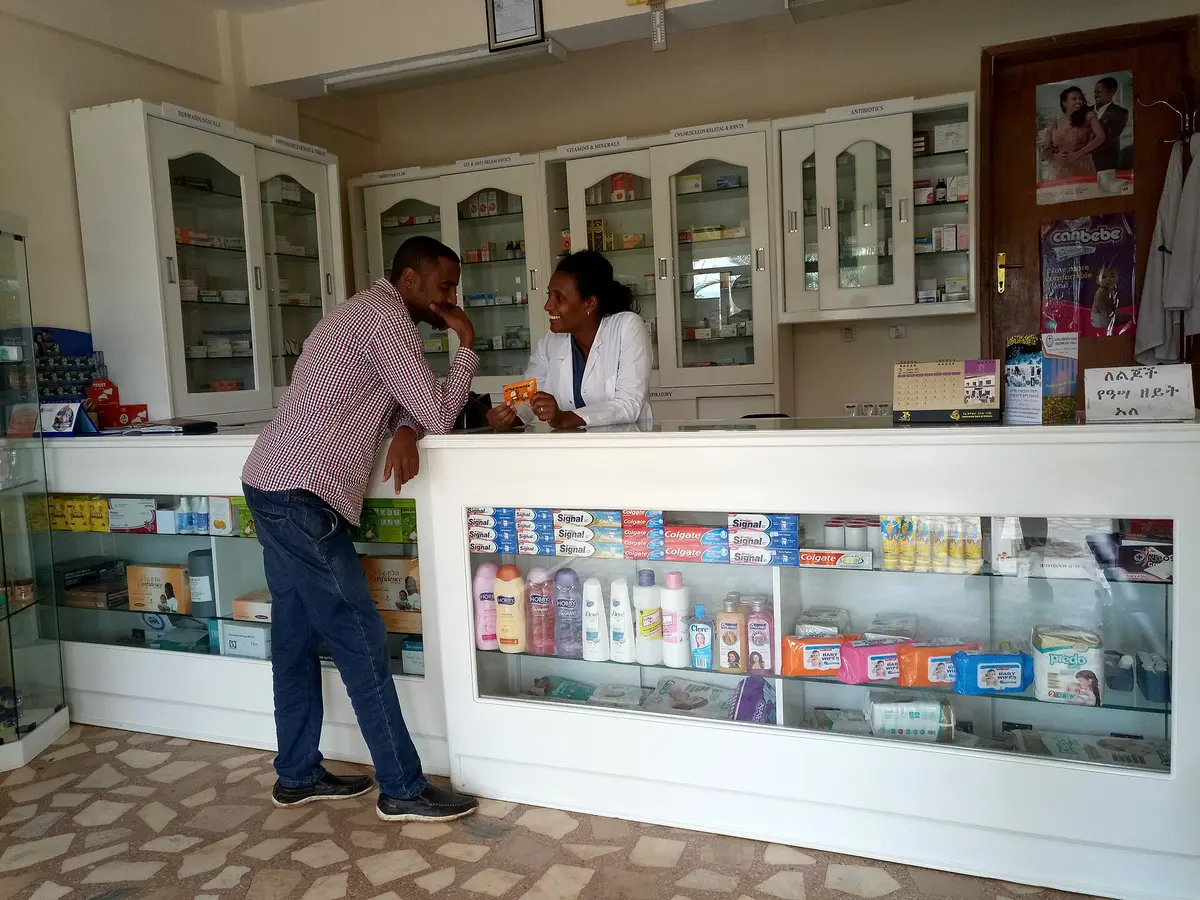 Photo: Genet girma, CC BY-SA 4.0, via Wikimedia Commons
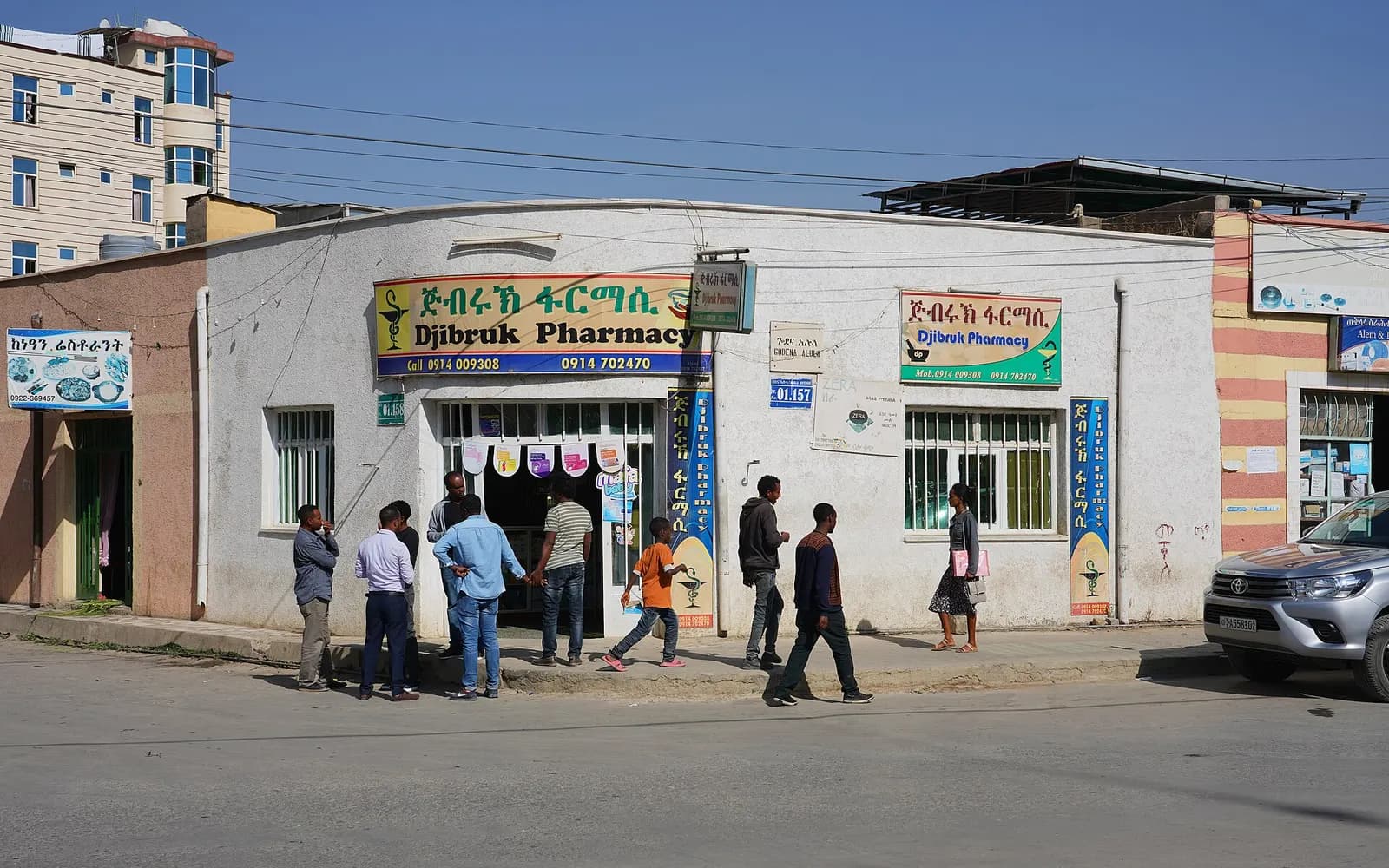
The level you study at decides which kind of outlet you can run. In Ethiopia, pharmacies are run only by pharmacists with a university degree or higher. Drug stores carry a narrower range of medicines and are run by druggists with a diploma in pharmacy. A national census in 2010 counted 377 community pharmacies, 1,669 drug stores and 1,392 rural drug vendors.
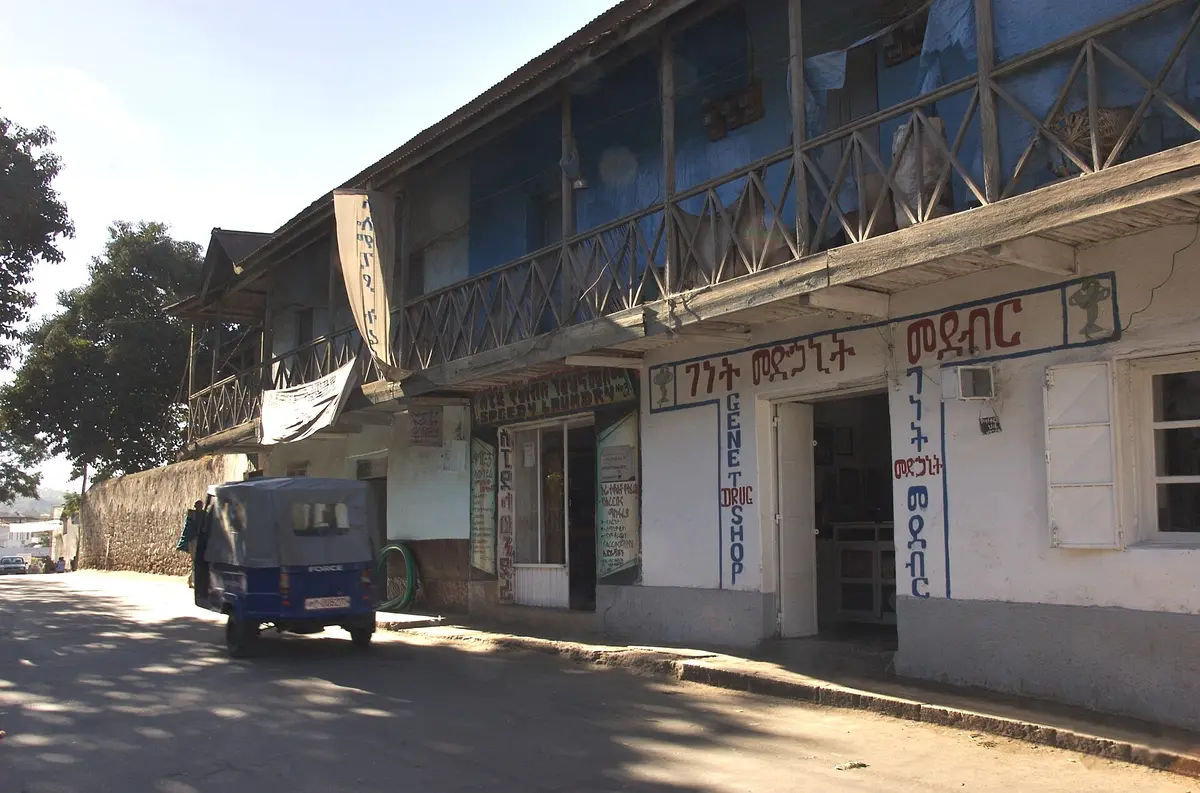 Photo: A. Davey, CC BY 2.0, via Wikimedia Commons
The same census counted 1,898 pharmacists, or 2.38 per 100,000 people. Density ranged from 0.66 per 100,000 in Afar to 29.88 in Addis Ababa. A 2023 estimate put the number of pharmacists at about 17,000, but it was derived from the total public-sector health workforce rather than counted directly. Pharmacists remain concentrated in Addis Ababa and the larger towns.
What no ranking measures: the licensing exam
Pharmacy is one of the 17 professions covered by the Ethiopian Health Professionals Licensure Examination, which the Ministry of Health launched in 2019 for seven professions and has since expanded. Since 2019, licence renewal has also been tied to continuing professional development.
However, the ministry does not publish pass rates for pharmacy, or for any profession by school. We could not find any study reporting them either. The university exit exam, introduced for all undergraduate programmes in 2022/23, has the same gap: only 40.65% of students passed the first round nationally, but no pharmacy figures have been released.
If you are choosing a school
- Ask for the licensing-exam and exit-exam pass rates of the last two or three classes. A good school will track them, even though the ministry doesn't publish them.
- Ask where the final-year clerkship happens. The clinical year is the core of the degree. A school with a large teaching hospital, a clinical pharmacy unit and a drug information centre, like Gondar or Addis Ababa, gives you more to learn from.
- Look at the graduate programmes if you want to specialise. Jimma, Gondar and Addis Ababa offer the widest choice, from clinical pharmacy to supply chain and regulatory affairs.
- Use EduRank for research strength only. It counts citations, not teaching quality.
- For a private college, get the programme's accreditation in writing and check it with the ETA.
- Decide between degree and diploma early. Only a degree lets you run a pharmacy. A diploma leads to drug-store work, and upgrading later means a post-basic programme.
After graduation
Most pharmacy graduates work in one of five areas:
- Hospital clinical pharmacy: the role the 2008 curriculum was built for. Since 2012, the Ministry of Health's hospital reform guidelines have included clinical pharmacy services in public hospitals.
- Community pharmacy: the largest private employer. A 2010 census found most pharmacists working in hospitals, sales and marketing, and community pharmacies.
- Industry: local medicine manufacturing, including quality-assurance and analysis roles.
- Regulation: the Ethiopian Food and Drug Authority (EFDA) regulates medicines under the Food and Medicine Administration Proclamation (No. 1112/2019).
- Supply chain: the public supplier, now the Ethiopian Pharmaceutical Supply Service (EPSS). It was set up under a 2007 proclamation and was previously known as the Ethiopian Pharmaceuticals Supply Agency (EPSA).
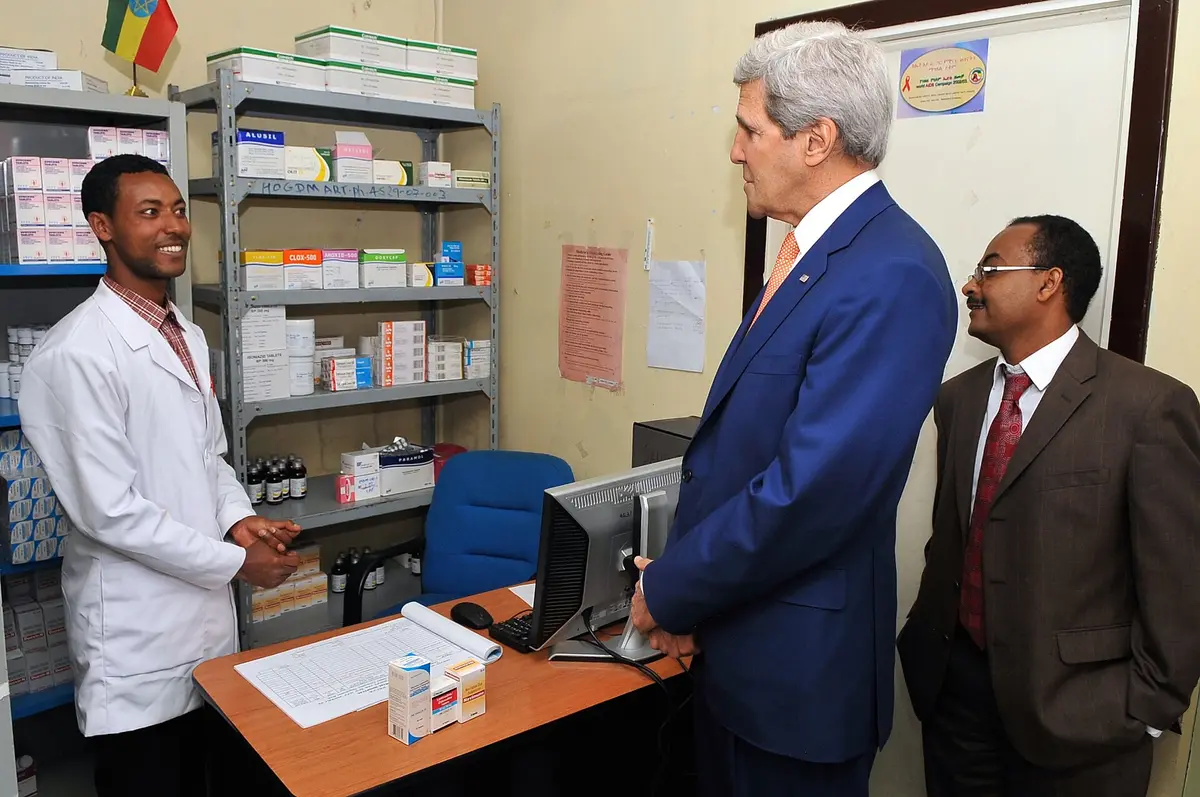 Photo: U.S. Department of State, public domain, via Wikimedia Commons
The national public health institute lists pharmacists among the cadres Ethiopia is still short of, but new graduates are not guaranteed jobs: funding for posts has not kept pace with training across the health professions. Our analysis of the health workforce gap looks at where the shortages and surpluses are.
Sources
Rankings
- EduRank. Best universities for pharmacy in Ethiopia and Best universities for pharmacology in Ethiopia, both updated 15 March 2026.
- uniRank. 2026 Ethiopian University Ranking.
- Ethiopian News Agency. Ministry to reorganize institutions of higher learning, 2020; Fana. Ethiopia names eight universities centres of excellence in research, 2020.
Pharmacy education in Ethiopia
- Bhagavathula AS. Clinical pharmacy in Ethiopia: an experience based literature review. Global Health (University of Findlay) 5(1), 2018. Source for the 2008 curriculum, the Howard partnership, Gondar's history and programmes, and the first drug information centre.
- Bilal AI, Tilahun Z, Beedemariam G, et al. Attitude and satisfaction of health care providers towards clinical pharmacy services in Ethiopia: a post-deployment survey. Journal of Pharmaceutical Policy and Practice 9:7, 2016. Source for the first 426 graduates in July 2013.
- Gebremariam ET, Gadisa DA. Evaluation of the undergraduate pharmacy student research projects in Ambo University, Ethiopia: retrospective review. Advances in Medical Education and Practice 12, 2021.
- Gutema GB, Hadera MG, Dagne AW, Mamo YA. The metamorphosis of pharmacy education in Ethiopia: the case of Mekelle University. International Journal of Pharmacy Teaching & Practices, 2011 (copy on Scribd). Source for the 1961 start at Addis Ababa and Mekelle's first B.Pharm class.
School profiles
- Addis Ababa: College of Health Sciences; University of Toronto–AAU pharmacy collaboration (TAAAC); master's programme listings on Mastersportal.
- Jimma: School of Pharmacy.
- Bahir Dar: College of Medicine and Health Sciences, Directorate of Pharmacy.
- Haramaya: Haramaya University takes over Hiwot Fana Hospital.
- Hawassa: College of Medicine and Health Sciences background.
- Debre Markos: Department of Pharmacy, Health Campus.
Workforce and practice
- World Health Organization, via Our World in Data. Pharmacists per 10,000 population.
- Gebretekle GB, Fenta TG. Assessment of the pharmacist workforce in Ethiopia. Ethiopian Journal of Health Development 27(2), 2013.
- Tamiru H, Huluka SA, Negash B, Hailu K, Mekonen ZT. National Continuing Professional Development (CPD) training needs of pharmacists in Ethiopia. Human Resources for Health 21:87, 2023.
- Kasahun AE, Woldeyohanins AE, Kifle ZD, et al. Compliance of private pharmacy retail outlets to narcotic drug regulations in Ethiopia. Inquiry, 2022. Source for who may run pharmacies and drug stores.
- Ethiopian Public Health Institute. National distribution of human resources from 2000-2020.
- Mesele A, Fikrie A, Melese Y, Seyoum W, Kebede S. Employment status and associated factors of Pharma College Hawassa Campus graduates of 2017 to 2020. Ethiopian Journal of Medical and Health Sciences 2(1), 2022.
Licensing, accreditation and regulation
- Ministry of Health. Ethiopian Health Professionals Licensure Examination (EHPLE).
- Addis Insight. Ethiopia's university exit exams: only 40.65% of students pass, July 2023.
- Addis Fortune. Private colleges in web of violation of accreditation and permit rules, May 2019; Education agency penalises two private colleges, November 2019.
- The Reporter. Education Authority revokes licenses of 52 private colleges, March 2026.
- Ethiopian Food and Drug Authority. About EFDA; Food and Medicine Administration Proclamation No. 1112/2019.
- Ministry of Health. Ethiopian Pharmaceuticals Supply Agency.
See Bloom in your clinic
Fewer no-shows, less paper, cleaner billing — in one calm system your team will actually use. Book a short demo and we'll show you how.