The Top Nursing Schools in Ethiopia, Compared
Nurses are Ethiopia's largest group of health workers, and dozens of universities and private colleges now train them. We compared the schools on the one ranking that covers nursing, traced the history back to 1949, and looked at the licensing-exam and employment figures every nursing student should see first.
Nurses are the largest group of health workers in Ethiopia. A 2026 health labour market analysis counted 66,917 nurses in 2024, against a needs-based requirement of 103,690. That is a shortfall of 36,773, the biggest of any profession it measured. WHO data show that nurses and midwives together reached 1.22 per 1,000 people in 2022, up from 0.74 the year before.
The country is training nurses quickly. It is also failing to employ many of the ones it trains. A 2024 World Bank brief put it plainly: unemployment among physicians and nurses is high, even though Ethiopia has far fewer of both than comparable countries.
That makes the choice of school matter more. Some schools produce graduates who pass the national licensing exam and find work, and some don't. Here is what the public evidence says about which schools are strongest.
The short answer
The University of Gondar, Addis Ababa University and Jimma University lead the only ranking that measures nursing specifically. Behind them come Mekelle, Bahir Dar and Haramaya, then Debre Markos and Hawassa.
Nursing produces two differences from the medicine rankings:
- Gondar, not Addis Ababa, ranks first.
- Debre Markos, a younger university, climbs into the top ten, and even into the top five for critical-care nursing.
As with medicine, St. Paul's Hospital Millennium Medical College is missing from every list, even though it runs five specialty nursing degrees.
How the schools compare
| School | EduRank Nursing 2026 (Ethiopia / Africa / world) | EduRank Critical Care Nursing (Ethiopia) | EduRank Medicine (Ethiopia) | Research university (2020) |
|---|---|---|---|---|
| University of Gondar | 1 / 6 / 305 | 1 | 2 | Yes |
| Addis Ababa University | 2 / 10 / 372 | 2 | 1 | Yes |
| Jimma University | 3 / 13 / 492 | 3 | 3 | Yes |
| Mekelle University | 4 / 23 / 709 | 4 | 4 | Yes |
| Bahir Dar University | 5 / 30 / 787 | 6 | 5 | Yes |
| Haramaya University | 6 / 39 / 894 | 7 | 6 | Yes |
| Debre Markos University | 7 / 45 / 1,025 | 5 | 8 | No |
| Hawassa University | 8 / 46 / 1,037 | 10 | 7 | Yes |
| Wollega University | 9 / 66 / 1,380 | — | 10 | No |
| Arba Minch University | 10 / 67 / 1,388 | 11 | 9 | Yes |
| St. Paul's (SPHMMC) | not listed | not listed | not listed | — |
A dash means the school is not on that EduRank list. "Research university" is the Ministry of Science and Higher Education's 2020 classification. EduRank's nursing list continues past tenth place with Debre Berhan, Mizan Tepi, Madda Walabu, Aksum and Adama Science and Technology.
How to read this table
- EduRank is the only public ranking with a nursing-specific table for Ethiopia. It is built from citations to nursing research: about 16,500 papers from 15 Ethiopian universities, cited about 440,000 times. It measures research output. It does not measure how well a school teaches nursing.
- EduRank does not separate undergraduate from postgraduate programmes, and it doesn't check what a university currently offers. A high place tells you the faculty publish a lot. It doesn't tell you the BSc is good.
- Private colleges and hospital colleges don't appear at all. They publish little research, and EduRank ranks universities. For them, accreditation and licensing results are the evidence that counts (see below).
A short history of nursing education in Ethiopia
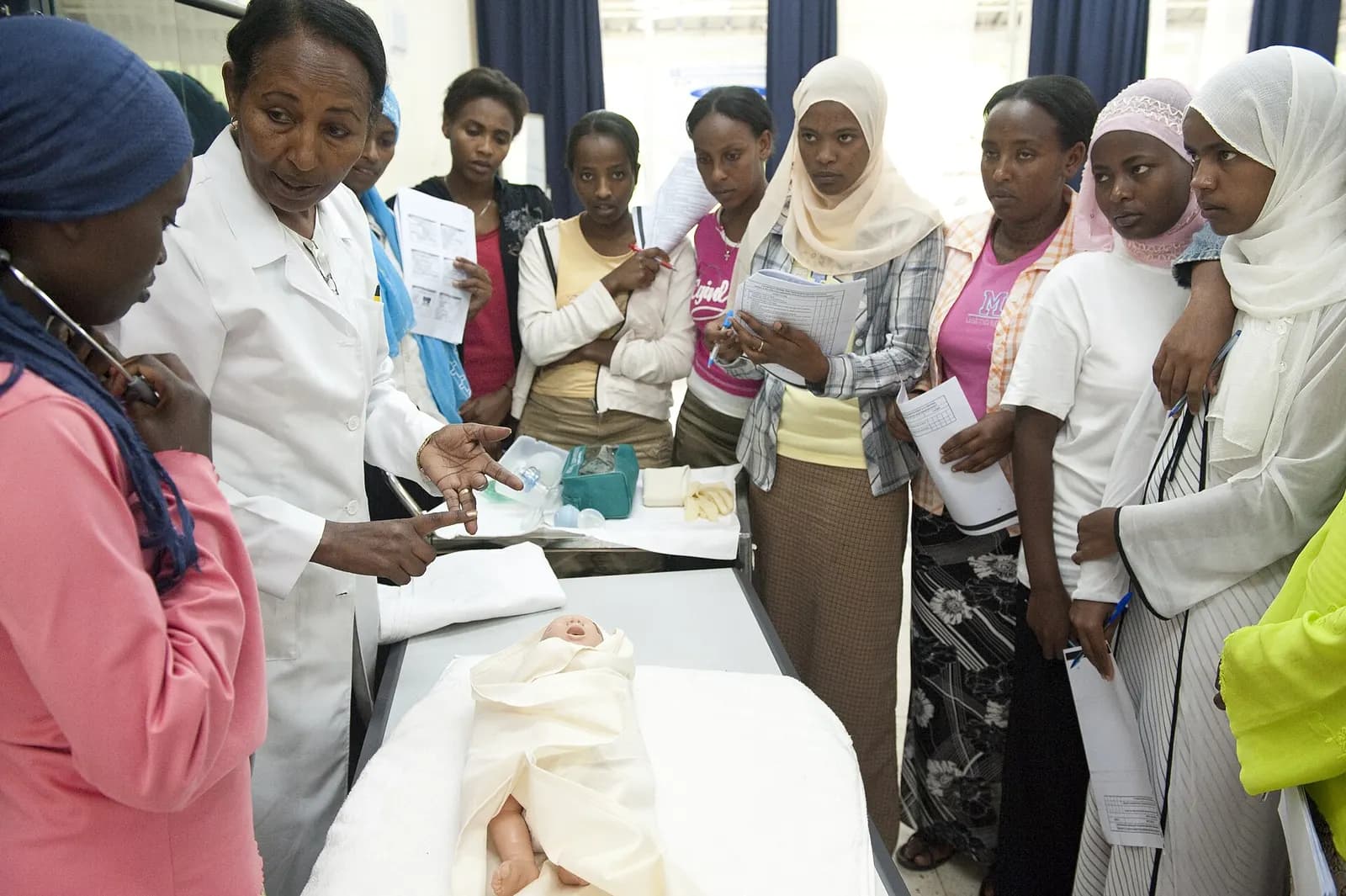
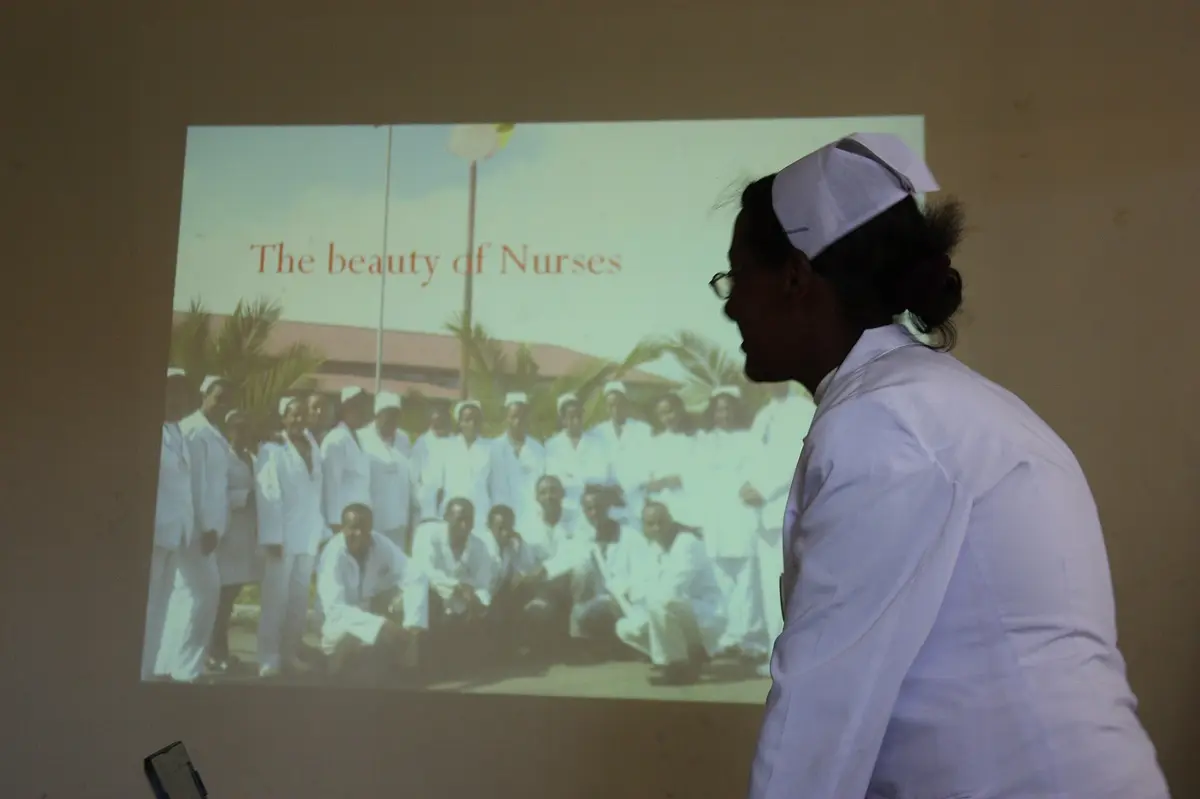 Photo: USAID Ethiopia, CC BY 2.0, via Wikimedia Commons
According to a 2016 review of Ethiopian nursing education:
- 1939: Princess Tsehai, Emperor Haile Selassie's daughter, trained in child health nursing in London and became the first Ethiopian national nurse.
- 1949: The Ethiopian Red Cross opened the first nursing school, a three-year programme at the Haile Selassie I Hospital in Addis Ababa. Its first class of 17 women graduated in 1953.
- 1951: A second school opened at the Princess Tsehai Memorial Hospital, run by Swedish missionaries. Both early schools took only women.
- 1954: Men were first admitted, at Teferi Mekonnen Hospital in Neqemte. The same year, the Public Health College in Gondar opened with a community-nurse department.
- 1994: Jimma Institute of Health Sciences started the first post-basic BSc in nursing. At first it graduated an average of about 30 nurses a year. By around 2004, BSc nursing had become one of the most common degrees at public and private universities.
- 2009 to 2011: Master's programmes began at Addis Ababa University in 2009, followed by Mekelle, Gondar and Jimma.
Doctoral training came later: a PhD in nursing started at Addis Ababa University in 2015, and Gondar's PhD in nursing and midwifery followed in 2018/19.
Today a BSc nurse can choose from several tracks. Comprehensive (general) nursing is the main one. Specialty degrees cover emergency and critical care, paediatric and child health, psychiatric, surgical, neonatal and operating-theatre nursing. Three of these specialties now have their own national licensing exam, separate from general nursing.
The schools, one by one
 1. University of Gondar
Profile, contacts and photos →
Gondar has trained nurses since its start as the Public Health College in 1954, when community nursing was one of its three original departments. It is now first in Ethiopia on EduRank for both nursing and critical-care nursing, and sixth in Africa for nursing.
Gondar also runs one of Ethiopia's earliest doctoral programmes in the field. A four-year PhD in nursing and midwifery started in 2018/19 with eight students (four nurses and four midwives), supported by Karolinska Institutet in Sweden. A published mid-term evaluation called it the first of its kind in East Africa.
 2. Addis Ababa University, School of Nursing and Midwifery
Profile, contacts and photos →
Addis Ababa's nursing school is part of the College of Health Sciences and teaches at Tikur Anbessa (Black Lion) Specialized Hospital, the country's largest referral hospital at about 700 beds. It has led postgraduate nursing in Ethiopia:
- 2009: The country's first master's in nursing, according to the 2016 review.
- By 2013: About 100 master's graduates, developed with the University of Toronto.
- 2013: A master's in critical-care nursing was due to open, focused on ICU, emergency and peri-operative care.
- 2015: Ethiopia's first PhD in nursing began, under an agreement with Emory University. Its students were based mainly in AAU's School of Public Health.
It ranks second for nursing and tenth in Africa.
 3. Jimma University, School of Nursing
Profile, contacts and photos →
Jimma has the deepest record in degree-level nursing. Its school was established in 1983 and launched Ethiopia's first post-basic BSc in nursing in 1994. It dates its own postgraduate teaching to 2008/09.
Its current numbers, from the school's page:
- Students: 212 undergraduates and 5 PhD students, alongside its master's cohorts.
- Staff: 51 academic staff, of whom 38 are active.
- Master's tracks: adult health, maternity, mental health, paediatrics and child health, emergency and critical care, and neonatology.
- In development: ophthalmic nursing, oncology nursing, palliative care and paramedic science.
Diploma nurses with at least two years of service can apply for its advanced-standing BSc.
 4. Mekelle University
Profile, contacts and photos →
Mekelle launched master's programmes in nursing in 2011. It ranks fourth for nursing on EduRank and 23rd in Africa. Its students train at the 500-bed Ayder Comprehensive Specialized Hospital.
The 2020–2022 war disrupted the university more than any other on this list. Higher education in Tigray was suspended from June 2021, and Ayder's patient volumes fell sharply. The research record is strong, but ask about the current state of clinical placements before you enrol.
 5. Bahir Dar University
Profile, contacts and photos →
Bahir Dar opened a dedicated Department of Emergency and Critical Care Nursing in 2008 in the Ethiopian calendar (about 2015/16), starting with post-basic students. By the department's own count it has graduated about 122 nurses: 73 post-basic and 49 generic. About 59 students were enrolled across three year groups. Clinical teaching is at Tibebe Ghion Specialized Hospital, which has more than 500 beds, including 20 ICU beds.
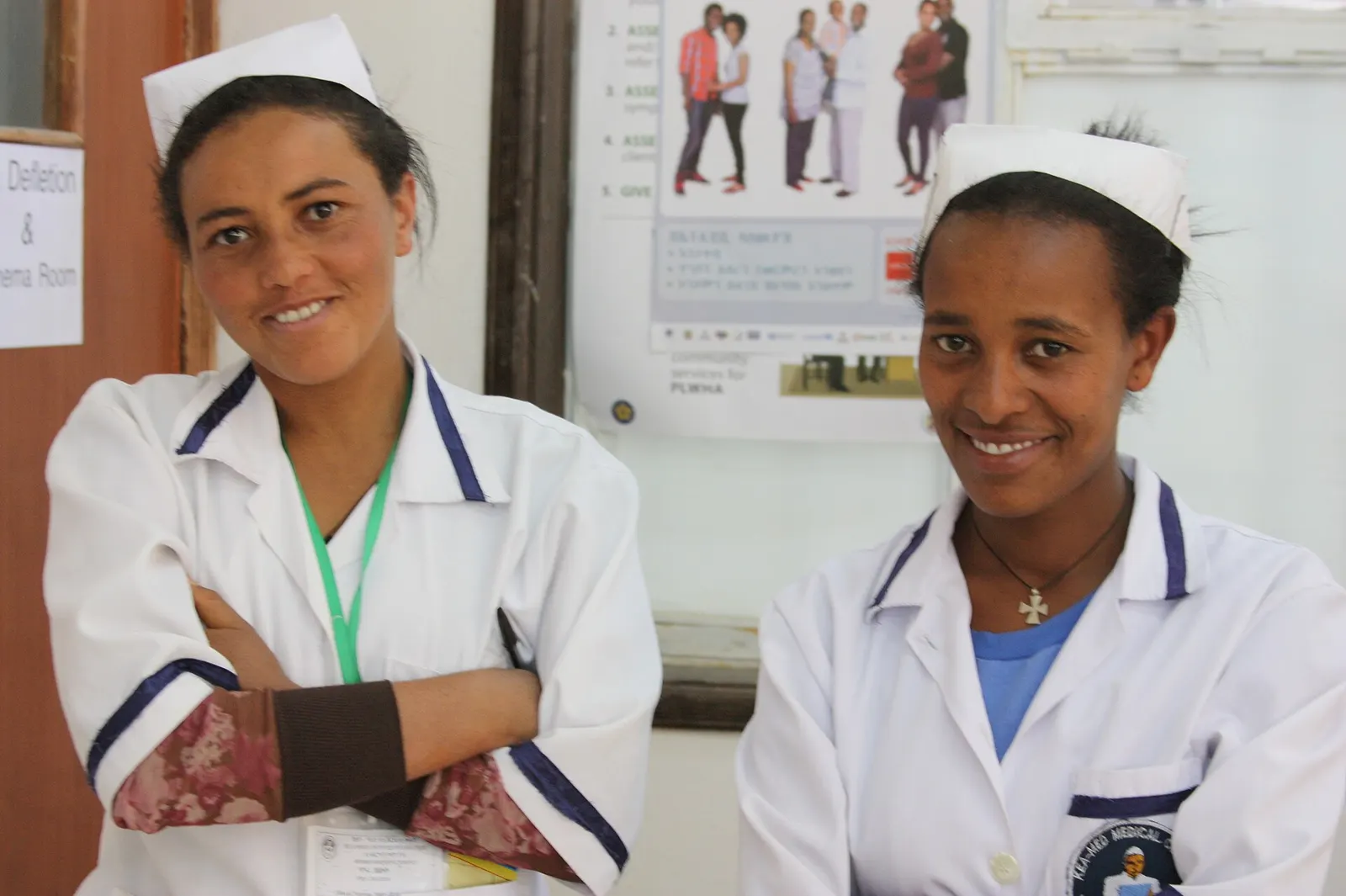
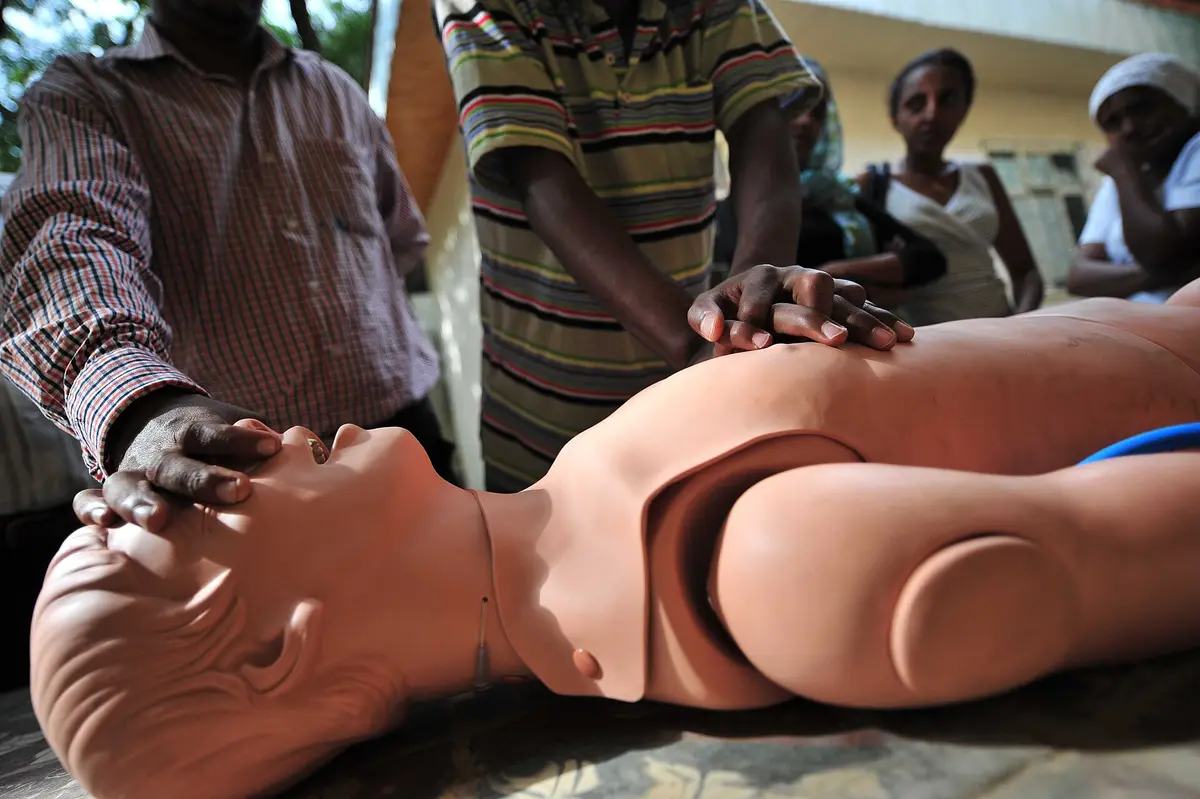 Photo: U.S. Air Force, Staff Sgt. Kat McDowell, Public domain, via Wikimedia Commons. Nurses at Dil Chora Hospital, Dire Dawa, on an emergency-skills refresher course in 2010; not one of the schools above.
 6. Haramaya University
Profile, contacts and photos →
Haramaya's School of Nursing and Midwifery sits in its College of Health and Medical Sciences. Clinical teaching is at Hiwot Fana Hospital in Harar, the referral hospital for eastern Ethiopia. It ranks sixth for nursing on EduRank and is one of the eight designated research universities.
 7. Hawassa University
Profile, contacts and photos →
Hawassa's School of Nursing was founded in 1996:
- Undergraduate: comprehensive nursing and psychiatric nursing.
- Master's: adult health, paediatrics and child health, and emergency and critical care nursing.
The college's nursing and midwifery service directorate counts more than 450 nurses and midwives across its clinical units. It ranks eighth for nursing on EduRank.
 Not on any list: St. Paul's Hospital Millennium Medical College
Profile, contacts and photos →
St. Paul's is a standalone hospital college with more than 700 beds, so the ranking sites skip it. Its nursing programme has grown in three steps:
- 2012: Its nursing directorate began in March with two specialty degrees, operating-theatre nursing and emergency and critical care nursing, with Trauma Care Ethiopia and the Children's Burn Care Foundation as partners.
- 2022: It became a School of Nursing.
- Today: It lists five specialty undergraduate programmes: paediatrics and child health, surgical, neonatal, emergency and critical care, and operating-theatre nursing.
If you want to specialise from the start and train inside a very busy hospital, it is worth a close look.
Also worth knowing
- Debre Markos University is the surprise of the nursing table. It is seventh for nursing and fifth for critical-care nursing, ahead of Bahir Dar, Haramaya and Hawassa. Its health college has a separate department of paediatrics and child health nursing.
- Wollega University is ninth. It is based in Nekemte (Neqemte), where men were first admitted to nursing training in 1954.
- Debre Berhan University is eleventh on EduRank. Its BSc nursing at the Asrat Weldeyes Health Science Campus holds provisional accreditation from the Education and Training Authority (ETA), valid from February 2026 to February 2029.
Private colleges: check accreditation first
Private colleges train a large share of Ethiopia's nurses. In the first national licensing exam in 2019, 1,829 of the 3,928 nursing graduates who sat it came from private health schools. None of these colleges appear on any ranking, so the useful questions are about regulation:
- Is the programme accredited? In 2019 the regulator, then called HERQA, audited 167 private institutions in and around Addis Ababa. It found irregularities at 46, and 27 were operating without accreditation. One college had been enrolling clinical-nursing students without a licence to graduate them; it was barred from admitting new nursing students for two years.
- Has the regulator acted on it? In March 2024 the ETA refused renewal for nearly 1,000 programmes at 50 institutions. The reasons included over-enrolment, poor facilities and admitting under-qualified students. In March 2026 it revoked the licences of 52 private colleges that had not completed mandatory re-registration. The published notice named only a few of them, and none were identified as health colleges.
- Will students pass the exit exam? Under ETA rules, an institution that fails to get 25% of its students through the national exit exam in three consecutive rounds cannot re-accredit its programmes.
The ETA's new online accreditation register is a good place to check, but it is still filling up. When we checked, it held only 13 accreditation records. A college missing from it is not necessarily unaccredited. Ask the college for its ETA certificate for the specific programme and campus, and check the expiry date.
What no ranking measures: the licensing exam
Since 2019, every nursing graduate must pass the Ethiopian Health Professionals Licensing Examination (EHPLE), run by the Ministry of Health, before getting a licence. The basics:
- Professions covered: 13 in the ministry's 2024 nursing booklet (its exam page now lists 17), including general nursing and three separate specialty exams for psychiatric, paediatric and child health, and emergency and critical-care nursing.
- Format: a computer-based, multiple-choice exam. The pass mark is set each round by an expert panel using the modified Angoff method.
- Scale: by February 2024, 166,293 candidates had sat it over 14 rounds.
The general nursing exam is weighted heavily towards patient care, at 80.5% of questions:
| Patient-care area | Share of the exam |
|---|---|
| Adult health nursing | 36.5% |
| Child health nursing | 27% |
| Maternal health nursing | 9.5% |
| Mental health nursing | 7.5% |
The rest covers health promotion, professionalism, leadership and research.
Pass rates by school are not published. The figures that are public show a large gap:
- 2019, the first round: about 75% of 2,099 nursing graduates from public universities passed, against 38% of 1,829 from private schools.
- 2024: a World Bank brief described licensing pass rates across professions as "worryingly low" at about 40%, with relicensing rates of 27%.
- University exit exam, 2024: among first-time takers in all fields, 69% from public institutions passed against 21% from private ones.
If you are choosing a nursing school
- Ask for the licensing-exam pass rate for the last two or three graduating classes. The ministry doesn't publish it by school, but schools receive their results.
- Check accreditation for your exact programme and campus. Ask for the ETA certificate and its expiry date. A college can be accredited for one programme and not another.
- Look at the teaching hospital. Nursing is learned on the wards. Bed numbers, an ICU, and a busy emergency department all shape your clinical years.
- Decide early whether you want a specialty. Emergency and critical care, paediatrics, neonatal, operating-theatre and psychiatric nursing are available as BSc degrees at some schools, and some have their own licensing exam.
- Know the upgrade path. Diploma nurses can usually join a BSc through post-basic (advanced-standing) entry. Jimma, for example, asks for at least two years of service.
- Use EduRank for research strength only. It tells you whether the faculty publish, which matters if you are aiming for a master's or PhD.
After graduation
 Photo: USAID Ethiopia, CC BY 2.0, via Wikimedia Commons
Nurses in Ethiopia work as clinicians, educators, managers and researchers. In health centres and outpatient settings, they often diagnose, treat and prescribe themselves. The career ladder now runs from diploma through BSc and specialty degrees to master's and PhD.
Getting the first job is the hard part. Graduation numbers have outrun funded posts:
- Wage bill: in 2019–20, about 65% of government health spending already went on wages.
- Positions needed: in 2020, facilities reported needing more than 26,000 new health posts.
- Absorption: the national labour-market analysis says fiscal limits restrict how many graduates the public sector can hire, "particularly among nurses". Its projections assume about 20% unemployment among new graduates.
The World Bank has also recommended paying specialised nurses more than general nurses, which is not yet the case. This is a reason to pick a specialty, and a school, with the job market in mind. If you are also weighing medicine, see our comparison of Ethiopia's medical schools.
Sources
Rankings
- EduRank. Best universities for Nursing in Ethiopia, updated 15 March 2026.
- EduRank. Best universities for Critical Care Nursing in Ethiopia, updated 15 March 2026.
- EduRank. Best Medical schools in Ethiopia.
- Ethiopian News Agency. Ministry to reorganize institutions of higher learning, 2020; Fana. Ethiopia names eight universities centres of excellence in research, 2020.
Nursing workforce
- Ali JM, Ayalew F, Abosse Z, et al. Examining the supply and need of health workforce in Ethiopia: A foundation for strategic investment in human resources for health. Public Health in Practice, 2026. Source for the 2024 nurse stock, requirement and deficit.
- World Bank. Nurses and midwives (per 1,000 people), Ethiopia (WHO data).
- Guracha TA, Watsa KP, Schneider P. World Bank calls for urgent investments to strengthen Ethiopia's health workforce. World Bank brief, June 2024.
History of nursing education
- Tilahun YG, Nasrabadi AN, Alemayehu M, Teklu AM, Charania NAMA. The journey of Ethiopian nursing education: a glimpse of past, present and future. International Journal of Current Research 8(02):26828–26833, 2016.
Licensing and exit exams
- Ministry of Health. Ethiopian Health Professionals Licensing Examination (EHPLE) Information Booklet: Nursing, 2024.
- Ethiopian Monitor. About 40% of health graduates fail to pass proficiency exams, 29 August 2019.
- Tamrat W. Addressing poor pass rate in HE exit exam remains urgent. University World News, 18 April 2024.
Accreditation and private colleges
- Addis Fortune. Private colleges in web of violation of accreditation and permit rules, May 2019.
- Addis Fortune. Accreditation crackdown sweeps higher education, March 2024.
- The Reporter. Education Authority revokes licenses of 52 private colleges, 31 March 2026.
- FDRE Education and Training Authority. Accreditation data management system (public register).
School profiles
- Gondar: Erlandsson K, Lindgren H, Wettergren L, et al. Half-time evaluation of a new 4-year Ph.D. program in nursing and midwifery at the University of Gondar, Ethiopia. Global Health Action, 2021.
- Addis Ababa: Nursing education crosses continents as Bloomberg lecturer returns to Ethiopia, University of Toronto, 2013; PhD nursing program is a first for Ethiopia, Emory Nursing Magazine, fall 2015; Black Lion Hospital.
- Jimma: School of Nursing, Jimma University Institute of Health.
- Mekelle: Ayder Hospital; war impact on Ayder's services, Conflict and Health 2023.
- Bahir Dar: Department of Emergency and Critical Care Nursing; Tibebe Ghion Specialized Hospital.
- Haramaya: Haramaya University takes over Hiwot Fana Hospital.
- Hawassa: Nursing and Midwifery, College of Medicine and Health Sciences.
- SPHMMC: School of Nursing; St. Paul's Hospital Millennium Medical College.
- Debre Markos: College of Health Sciences.
See Bloom in your clinic
Fewer no-shows, less paper, cleaner billing — in one calm system your team will actually use. Book a short demo and we'll show you how.