Where to Study Midwifery in Ethiopia: The Schools, the Degrees and the Licensing Exam
Ethiopia went from about 1,400 midwives in 2008 to more than 20,000 today, and two in three births now have a skilled attendant. We looked at which universities and colleges train midwives, what the BSc, MSc and PhD routes involve, and what the rankings and licensing exam can and can't tell you.
In 2008 Ethiopia had 1,379 midwives. By 2014 it had 9,244, and a 2025 study using Ministry of Health figures put the number at about 25,285 in 2024. UNFPA's global midwifery coordinator told NPR in 2026 that the country now has "over 20,000". Few countries have expanded a profession that fast.
The results show up in the national health survey. In the 2024–25 Ethiopia Demographic and Health Survey, 64% of births were assisted by a skilled provider, up from 12% in 2011, and 61% took place in a health facility. The survey's pregnancy-related mortality ratio fell to 169 deaths per 100,000 live births, from 412 in the 2016 survey and 871 in 2000.
More than 30 public universities, a network of regional health colleges and a few non-profit and private colleges now train midwives. This guide covers which ones stand out, what the degrees lead to, and how to check a programme before you apply.
The short answer
The University of Gondar has the deepest history and the widest range of programmes. It ran Ethiopia's first Master's in Clinical Midwifery (2010) and East Africa's first PhD in Midwifery and Women's Health. Addis Ababa University and Jimma University follow it on EduRank's nursing and obstetrics lists. The Hamlin College of Midwives is the most distinctive option: a small, scholarship-funded college that recruits students from rural areas and sends them back home to work.
There is no ranking for midwifery in Ethiopia. The closest proxies are research rankings for nursing and for obstetrics and gynaecology, which measure published research, not how well a school trains midwives.
The degrees
Midwifery training in Ethiopia comes in three undergraduate forms:
- Direct-entry BSc in Midwifery at a university, usually four years from secondary school. Universities call this the generic programme.
- Direct-entry diploma at a TVET (technical and vocational) college.
- Post-basic programmes that build on an earlier qualification. Gondar awarded the first post-basic BSc in 2004, a year before its first generic BSc.
At postgraduate level there are two main routes:
- MSc in Clinical Midwifery. This is a non-physician clinician programme with comprehensive emergency obstetric care competencies, including caesarean section. Graduates are trained to do life-saving obstetric surgery where obstetricians are scarce. In 2022, seven universities ran it: Gondar, Hawassa, Wollo, Arba Minch, Debre Tabor, Bahir Dar and Mekelle. Cohorts were small, averaging seven or eight students per university.
- Research and teaching master's and PhDs, such as Midwifery and Women's Health (Gondar, Debre Berhan). Maternity and neonatal care are also taught as nursing specialties; our guide to nursing schools covers those.
How the schools compare
| School | EduRank Nursing 2026 (Ethiopia / world) | EduRank OB-GYN 2026 (Ethiopia / world) | uniRank 2026 (Ethiopia) | Midwifery degrees (confirmed) |
|---|---|---|---|---|
| University of Gondar | 1 / 305 | 1 / 603 | 2 | BSc, MSc Clinical, PhD |
| Addis Ababa University | 2 / 372 | 2 / 615 | 1 | see text |
| Jimma University | 3 / 492 | 3 / 733 | 3 | BSc |
| Mekelle University | 4 / 709 | 6 / 1,100 | 5 | BSc, MSc Clinical |
| Bahir Dar University | 5 / 787 | 4 / 970 | 4 | BSc, MSc Clinical |
| Haramaya University | 6 / 894 | 7 / 1,109 | 7 | BSc, master's |
| Hawassa University | 8 / 1,037 | 5 / 976 | 6 | BSc, MSc Clinical |
| Debre Markos University | 7 / 1,025 | 8 / 1,459 | 19 | not confirmed |
| Arba Minch University | 10 / 1,388 | 10 / 1,598 | 10 | BSc, MSc Clinical |
| Debre Berhan University | 11 / 1,652 | 12 / 1,678 | 13 | BSc, master's, PhD |
| Debre Tabor University | not listed | not listed | 36 | BSc, MSc Clinical |
| Hamlin College of Midwives | not listed | not listed | not listed | BSc, MSc Clinical |
"Confirmed" means we found the programme on the institution's own website or in a published study. A school may offer more than is listed here.
How to read this table
- EduRank counts citations to research papers in a subject. There is no midwifery category, so we show nursing and obstetrics–gynaecology. Both reward research output, mostly by staff, not teaching quality.
- uniRank measures web popularity across the whole university. It says nothing about midwifery.
- Neither ranks colleges. Hamlin and the regional health science colleges don't appear on any list.
The schools, one by one
 1. University of Gondar, School of Midwifery
Profile, contacts and photos →
Gondar describes its School of Midwifery as "by far the largest midwifery training institute in Ethiopia". Its history:
- 1959: midwifery training began, as a nine-month course for nurses.
- 1986: after a pause that began in 1978, training restarted at certificate level with Swedish (SIDA) support.
- 1998 to 2005: direct-entry diploma (1998), first post-basic BSc (2004) and first generic BSc (2005).
- 2010: the country's first Master's in Clinical Midwifery.
- 2017/18: a PhD in Midwifery and Women's Health, built with Karolinska Institutet in Sweden. A published evaluation called it the first of its kind in East Africa. The first PhDs graduated in August 2022.
Midwifery became a separate school in 2018, with departments of General Midwifery, Clinical Midwifery, and Women's and Family Health. Gondar is first in Ethiopia on EduRank for both nursing and obstetrics–gynaecology.
 2. Addis Ababa University, School of Nursing and Midwifery
Profile, contacts and photos →
AAU's College of Health Sciences is based at Tikur Anbessa Specialized Hospital, the country's largest referral hospital. Its theses archive shows a Department of Midwifery and a long run of master's research in maternity and reproductive health. In 2015 it started Ethiopia's first nursing PhD with Emory University, a programme set up to train nurses and midwives in research. AAU is second for both nursing and obstetrics–gynaecology on EduRank.
AAU's website did not load a current programme list when we checked, so ask the school directly which midwifery degrees are open to new students.
 3. Jimma University, School of Midwifery
Profile, contacts and photos →
Jimma started midwifery in 2003 in the Ethiopian calendar (about 2010/11), as a unit within nursing. It became an independent department on 8 July 2020, with 28 academic staff. Jimma is known for community-based education, and the midwifery programme follows that model. Its stated plans include an MSc in Clinical Midwifery, an MSc in Midwifery Education and a PhD in Midwifery and Women's Health. Check which of these are now open.
 4. Hamlin College of Midwives
Profile, contacts and photos →
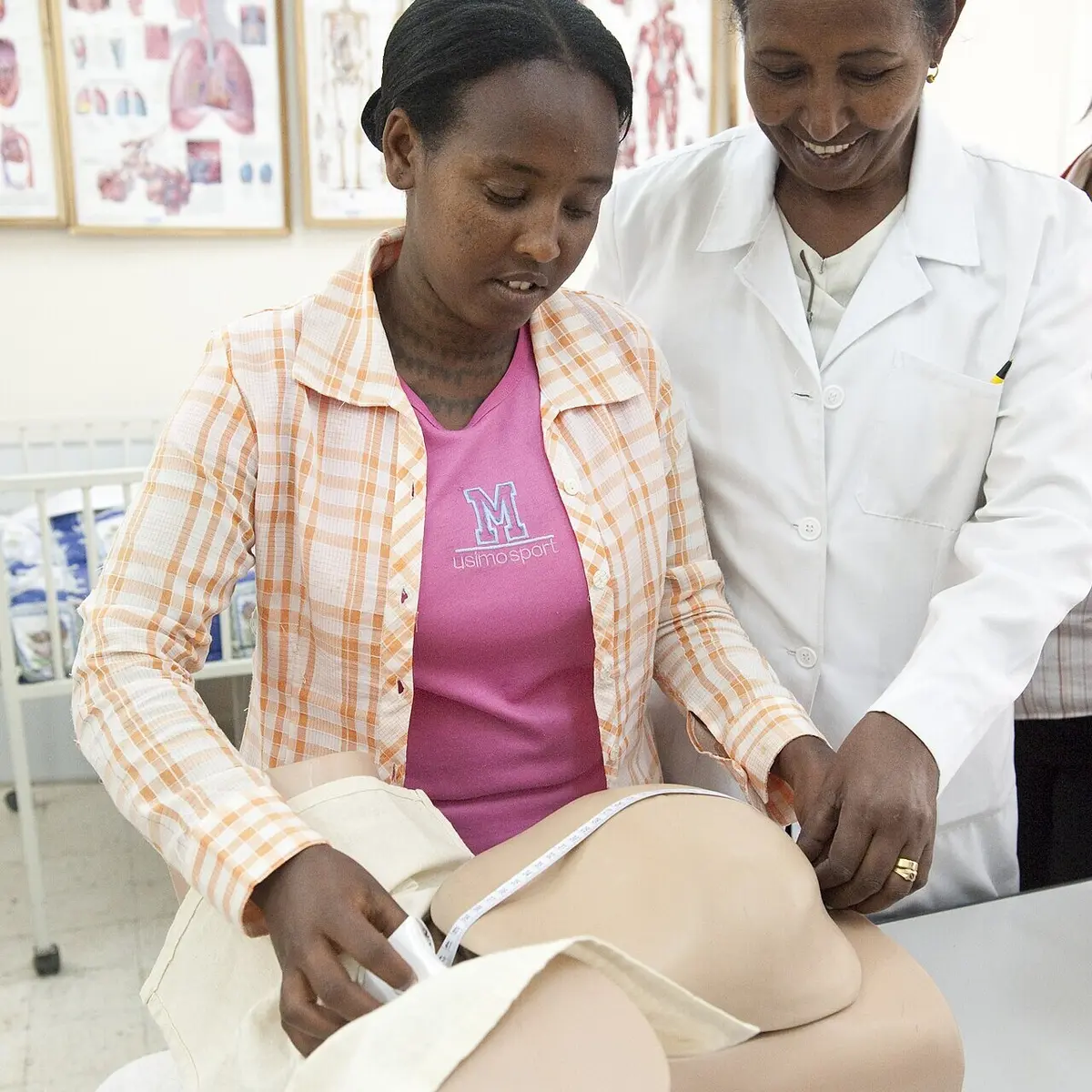 Photo: DFAT (Australian Government), CC BY 4.0, via Wikimedia Commons
Catherine Hamlin, co-founder of the Addis Ababa Fistula Hospital, opened this college in 2007 with a single aim: to prevent obstetric fistula, a childbirth injury whose main cause is the lack of skilled help during labour. The model works differently from a university:
- Rural recruitment. Students are chosen from rural areas after grade 12.
- Full scholarships. Every student is funded and commits to work as a Hamlin midwife for at least three years after graduating.
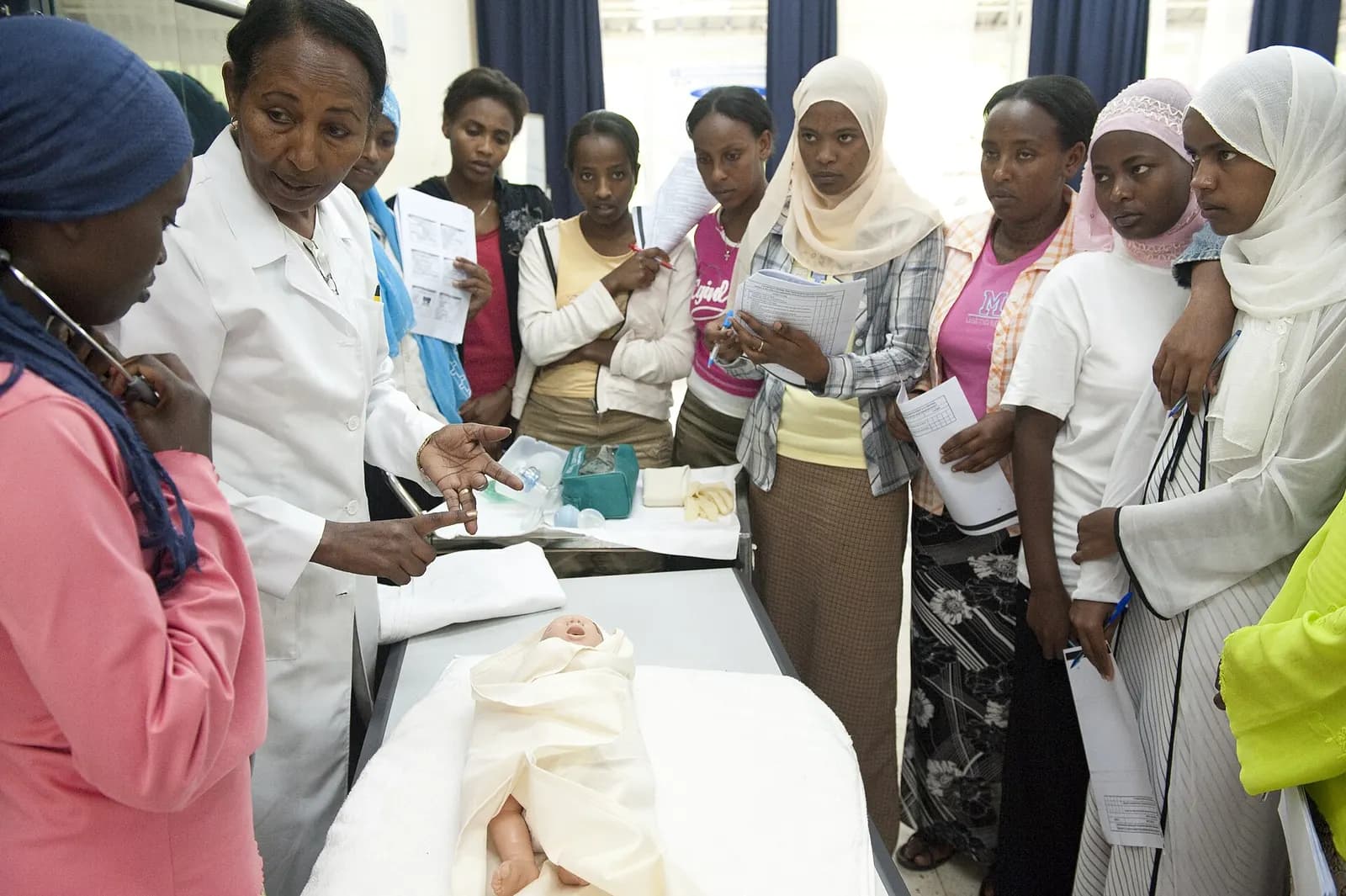
- More hands-on births. Students must conduct at least 40 deliveries before graduating. That is the International Confederation of Midwives standard and double Ethiopia's national minimum of 20.
- Deployment home. Graduates return to their home areas to staff Hamlin-supported rural midwifery clinics. The college reports more than 90 of these clinics.
The college reports 294 graduates since 2007, which makes it small. The Ministry of Health has called it a "Model College" for midwifery education, and in 2017 Hamlin reported a 100% pass record on the national licensing exam. Hamlin says its undergraduate and master's programmes are accredited by the Education and Training Authority (ETA) and the Ministry of Health. It also offers an MSc in Clinical Midwifery (two and a half years).
 5. Haramaya University, School of Midwifery
Profile, contacts and photos →
Haramaya's students train at Hiwot Fana Comprehensive Specialized Hospital in Harar, a referral hospital serving more than 5 million people. The International Confederation of Midwives profiled the school in 2026. It reported more than 250 undergraduate students on a four-year curriculum adapted from the ICM framework, as well as master's students. Haramaya's head of midwifery, interviewed by NPR, said classes are now about half men and half women.
 6. Hawassa University
Profile, contacts and photos →
Hawassa's Midwifery Department was founded in 1999 E.C. (about 2006/07). It runs a BSc in Midwifery and an MSc in Clinical Midwifery, and since April 2024 sits within a combined nursing and midwifery academic and service directorate. Hawassa ranks fifth in Ethiopia for obstetrics–gynaecology research on EduRank.
 7. Bahir Dar University
Profile, contacts and photos →
Bahir Dar's Midwifery Department runs undergraduate and postgraduate programmes, including the MSc in Clinical Midwifery. It reports 33 faculty members: 3 associate professors, 14 assistant professors and 16 lecturers, with six more studying for PhDs. It also has a skills lab with high-fidelity mannequins.
 8. Mekelle University
Profile, contacts and photos →
Mekelle has a Department of Midwifery that teaches at Ayder Comprehensive Specialized Hospital, and it is one of the seven universities that offered the MSc in Clinical Midwifery in 2022. The 2020–2022 war suspended teaching. A 2023 study of the clinical-midwifery programme left Mekelle out because it "was not operating because of conflict situations". Ask about current intake and clinical placements before applying.
 9. Arba Minch University
Profile, contacts and photos →
Arba Minch launched midwifery in 2010 and added the MSc in Clinical Midwifery in 2017. The programme had 52 graduates by 2023. Its midwifery programme also holds provisional accreditation in the ETA's new online register (issued May 2025, valid to May 2028).
 10. Debre Berhan University
Profile, contacts and photos →
Debre Berhan's BSc in Midwifery is the only midwifery programme marked "fully accredited" in the ETA's new online register. The accreditation was issued in February 2026 and runs to 2031. The school offers:
- a BSc in Midwifery;
- a master's in Midwifery and Women's Health;
- a PhD in Midwifery and Women's Health.
The school says its students achieved a 100% pass rate on the licensing and exit exams, but it does not give the year or class.
 11. Debre Tabor University
Profile, contacts and photos →
Debre Tabor is newer and doesn't rank well, but it matters for one reason: its curriculum. In 2013 it introduced a competency-based midwifery curriculum, with support from the Jhpiego-led Human Resources for Health project, and other universities followed. The curriculum stresses early clinical exposure and performance-based assessment. A 2025 study assessed 68 BSc graduates from ten universities delivering care:
- Graduates of competency-based curricula scored 83.3% on labour and delivery care quality.
- Graduates of conventional curricula scored 68.2%.
Debre Tabor also runs the MSc in Clinical Midwifery.
Also worth knowing
- Wollo University runs the MSc in Clinical Midwifery. It had the second-largest group of students in the 2022–23 study, after Gondar.
- Debre Markos University is seventh for nursing research on EduRank. We could not confirm its midwifery programmes from an official page.
- Arsi University's midwifery programme holds provisional ETA accreditation (February 2026).
Check accreditation, especially at private colleges
In March 2026 the ETA revoked the licences of 52 private colleges that had not completed mandatory re-registration. For midwifery specifically:
- The ETA's new online register (accreditation.neta.gov.et) listed 13 programme accreditations when we checked. Three were midwifery: Debre Berhan (full), Arba Minch and Arsi (both provisional). The register is new, so a missing programme is not necessarily unaccredited. Ask for the ETA certificate for your programme and campus.
- The licensing exam depends on accreditation. Graduates are registered for the licensing exam from lists sent by the ETA or the Ministry of Education. A graduate from an unrecognised programme can be left out.
- Private colleges advertise BSc Midwifery on aggregator sites, but we could not verify accreditation for any of them from an official source. That is why we haven't listed them.
What no ranking measures: the licensing exam
Ethiopia has given a national licensing exam for BSc midwifery graduates since 2015. Since 2019 midwifery has been part of the Ministry of Health's Ethiopian Health Professionals Licensure Examination (EHPLE), which now covers 17 professions. The essentials:
- Format: 200 multiple-choice questions, built from a task analysis of what practising midwives actually do.
- Pass mark: set by an expert panel after each round, using the modified Angoff method.
- Frequency: scheduled roughly three times a year.
- Licence: you cannot get a licence from a regional health bureau without passing.
The ministry does not publish results by school. A 2025 study put the midwifery pass rate at about 41%, but it cited a non-government website rather than an official release, so treat that figure with caution.
Older evidence explains the concern. A 2013 assessment tested 484 graduating midwifery students from 25 public institutions:
- Births attended: only 32% had attended the national minimum of 20 births during training, and just 6% had reached 40.
- Skills: the average score was 51.8%, and only 31.6% scored above the 60% pass standard.
- Universities vs. TVET colleges: university students were almost twice as likely as TVET students to reach 20 births.
If you are choosing a midwifery school
- Ask how many births students attend. The national minimum is 20 and the ICM standard is 40. This is the single best question to ask any school.
- Ask for the licensing-exam pass rate for the last two or three graduating classes, by programme.
- Ask whether the curriculum is competency-based. The 2025 comparison found a 15-point gap in the quality of care.
- Look at the teaching hospital's labour ward. At a busy referral hospital such as Hiwot Fana, some days bring more than 10 or 15 births, which means more supervised practice.
- Check the ETA certificate for the exact programme and campus, and its expiry date.
- Think about where you want to work. Hamlin's bonded scholarship suits students who want to serve rural communities. The MSc in Clinical Midwifery is the route to emergency obstetric surgery.
- Join the Ethiopian Midwives Association. Founded in 1992, EMwA represents midwives to the government and accredits continuing professional development courses.
After graduation
Demand for midwives is still rising: Ethiopia's health labour market analysis projects about 30,980 midwives by 2030. But in Ethiopia, training more health workers has not automatically meant enough paid posts, and the analysis assumes about 20% unemployment among new graduates. Rural areas still struggle to keep midwives. Haramaya's head of midwifery told NPR that graduates often stay in cities and called for better incentives to work in rural areas.
Sources
Rankings and accreditation
- EduRank. Best universities for Nursing in Ethiopia and Best universities for Obstetrics and Gynecology in Ethiopia, both updated 15 March 2026.
- uniRank. 2026 Ethiopian University Ranking.
- FDRE Education and Training Authority. Accreditation Data Management System, accredited institutions and programmes list.
- The Reporter. Education Authority Revokes Licenses of 52 Private Colleges, 31 March 2026.
Midwifery workforce and outcomes
- Ethiopian Statistics Service and ICF. Ethiopia Demographic and Health Survey 2024–25: Key Indicators Report, 2026.
- Yigzaw T, Carr C, Stekelenburg J, et al. Using task analysis to generate evidence for strengthening midwifery education, practice, and regulation in Ethiopia. International Journal of Women's Health 8:181–190, 2016. Source for the 2008 and 2014 midwife counts, the three programme types and the 2015 licensing exam.
- Wondie AG, Siebeck M, Sendekie TY, Fischer MR, Berndt M. Does Curriculum Reform Improve Clinical Practice? Comparing the Quality of Labor and Delivery Care Provided by Midwives in Ethiopia. Advances in Medical Education and Practice 16:2259–2270, 2025. Source for the 2024 midwife count, the Debre Tabor curriculum and the 41% pass-rate figure.
- Emanuel G. Midwives saved his mom's life — and inspired him to pursue the profession. NPR, 5 May 2026.
- Ali JM, Ayalew F, Abosse Z, et al. Examining the supply and need of health workforce in Ethiopia: A foundation for strategic investment in human resources for health. Public Health in Practice, 2026.
- UNFPA. State of the World's Midwifery 2014: Ethiopia profile. Source for the Ethiopian Midwives Association's founding year.
Licensing and training quality
- Ministry of Health. Ethiopian Health Professionals Licensure Examination and EHPLE frequently asked questions, 2024.
- Yigzaw T, Ayalew F, Kim YM, et al. How well does pre-service education prepare midwives for practice: competence assessment of midwifery students at the point of graduation in Ethiopia. BMC Medical Education 15:130, 2015.
- Tadesse D, Weldemariam S, Hagos H, Sema A, Girma M. Midwifery as a Future Career: Determinants of Motivation Among Prep Students in Harar, Eastern Ethiopia. Advances in Medical Education and Practice 11:1037–1044, 2020. Source for the 31 public universities with direct-entry programmes.
- Alemu FM, Yimer NB, Kasegn BB, et al. Effectiveness of simulation-based cesarean section education on improving non-physician clinician midwife's competency in performing cesarean section in Ethiopia: a quasi-experimental study. BMC Medical Education, 2023. Source for the MSc in Clinical Midwifery, the seven universities and the Arba Minch history.
School profiles
- Gondar: University of Gondar College of Medicine and Health Sciences, "About the School of Midwifery" and "Programs" pages (cmhs.uog.edu.et); Erlandsson K, Lindgren H, Wettergren L, et al. Half-time evaluation of a new 4-year Ph.D. program in nursing and midwifery at the University of Gondar, Ethiopia. Global Health Action, 2021.
- Addis Ababa: AAU Electronic Theses and Dissertations, School of Nursing and Midwifery; Emory Nursing. PhD nursing program is a first for Ethiopia, Fall 2015.
- Jimma: School of Midwifery, Institute of Health.
- Hamlin: Hamlin Fistula Ethiopia. Prevention Program; HCM recognized as model of excellence, 2017; Hamlin College of Midwives partners with Karolinska Institutet and the Ethiopian Midwives Association, 2026.
- Haramaya: International Confederation of Midwives. A day in the life of Dawit Tamiru, the midwife training Ethiopia's next generation, 2026.
- Hawassa: Nursing and Midwifery, College of Medicine and Health Sciences.
- Mekelle, Wollo, Arba Minch, Debre Tabor: see Alemu et al. 2023 and Wondie et al. 2025 above.
- Bahir Dar: Department of Midwifery, College of Medicine and Health Sciences.
- Debre Berhan: School of Nursing and Midwifery, Asrat Weldeyes Health Science Campus.
See Bloom in your clinic
Fewer no-shows, less paper, cleaner billing — in one calm system your team will actually use. Book a short demo and we'll show you how.